5 Dysfunctions of a Team
 Our team at Central is going through Patrick Lencioni’s book The Five Dysfunctions of a Team. Most of the book is a leadership story that encapsulates the principles in the book. The story itself is definitely what makes the book good. The explanation afterward is somewhat dry but it makes sure that each of the concepts is explained.
Here are some of my favorite quotes from it:
Our team at Central is going through Patrick Lencioni’s book The Five Dysfunctions of a Team. Most of the book is a leadership story that encapsulates the principles in the book. The story itself is definitely what makes the book good. The explanation afterward is somewhat dry but it makes sure that each of the concepts is explained.
Here are some of my favorite quotes from it:
“If you could get all the people in an organization rowing in the same direction, you could dominate any industry, in any market, against any competition, at any time.â€This is an amazing idea to think about. Whatever industry you are in, teamwork can make all the difference at whether you succeed.
“And as harsh as that may sound, Ken always says that his job is to create the best team possible, not to shepherd the careers of individual athletes. And that’s how I look at my job.â€This is from the story part of the book, but I loved the idea that as a leader the team must always be the focus, not the benefit of individuals. This is hard for me. I’d like to think that there could be a win-win in most scenarios but I think that leaders need to know in advance which way to choose if they ever become at odds.
“Some people are hard to hold accountable because they are so helpful. Others because they get defensive. Others because they are intimidating. I don’t think it’s easy to hold anyone accountable, not even your own kids.â€Pretty self explanatory, but so good. There is also a pyramid of the five dysfunctions and it looks like this:
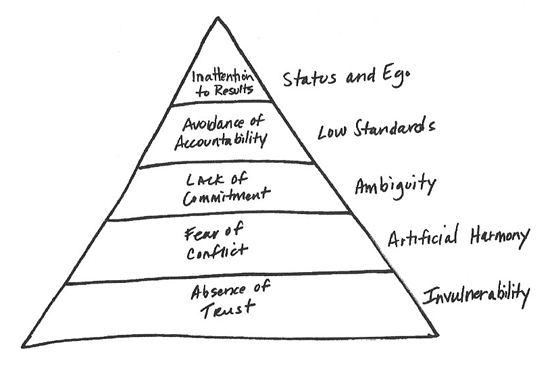
“These dysfunctions can be mistakenly interpreted as five distinct issues that can be addressed in isolation of the others. But in reality they form an interrelated model, making susceptibility to even one of them potentially lethal for the success of a team.” “And so, like a chain with just one link broken, teamwork deteriorates if even a single dysfunction is allowed to flourish.”Finally, the most powerful insight to me was the need for peer to peer accountability. When I look at how I have run my own team, I realize that I haven’t stressed this area enough. Instead of the leader carrying the burden for accountability, he or she can disperse it throughout the team to supplement his or her own efforts. As Lencioni explains:
“As politically incorrect as it sounds, the most effective and efficient means of maintaining high standards of performance on a team is peer pressure. One of the benefits is the reduction of the need for excessive bureaucracy around performance management and corrective action. More than any policy or system, there is nothing like the fear of letting down respected teammates that motivates people to improve their performance.”
Do You Want to Read the Bible Without Falling Behind?
Sign up your email and I’ll send you a PDF to download and use my custom-made reading plan system. There’s no way to fall behind on this system and every day will be different no matter how long you use it!
I’ll send future content directly to your inbox AND you can dive into the Bible like never before.
Download Your Free Copy